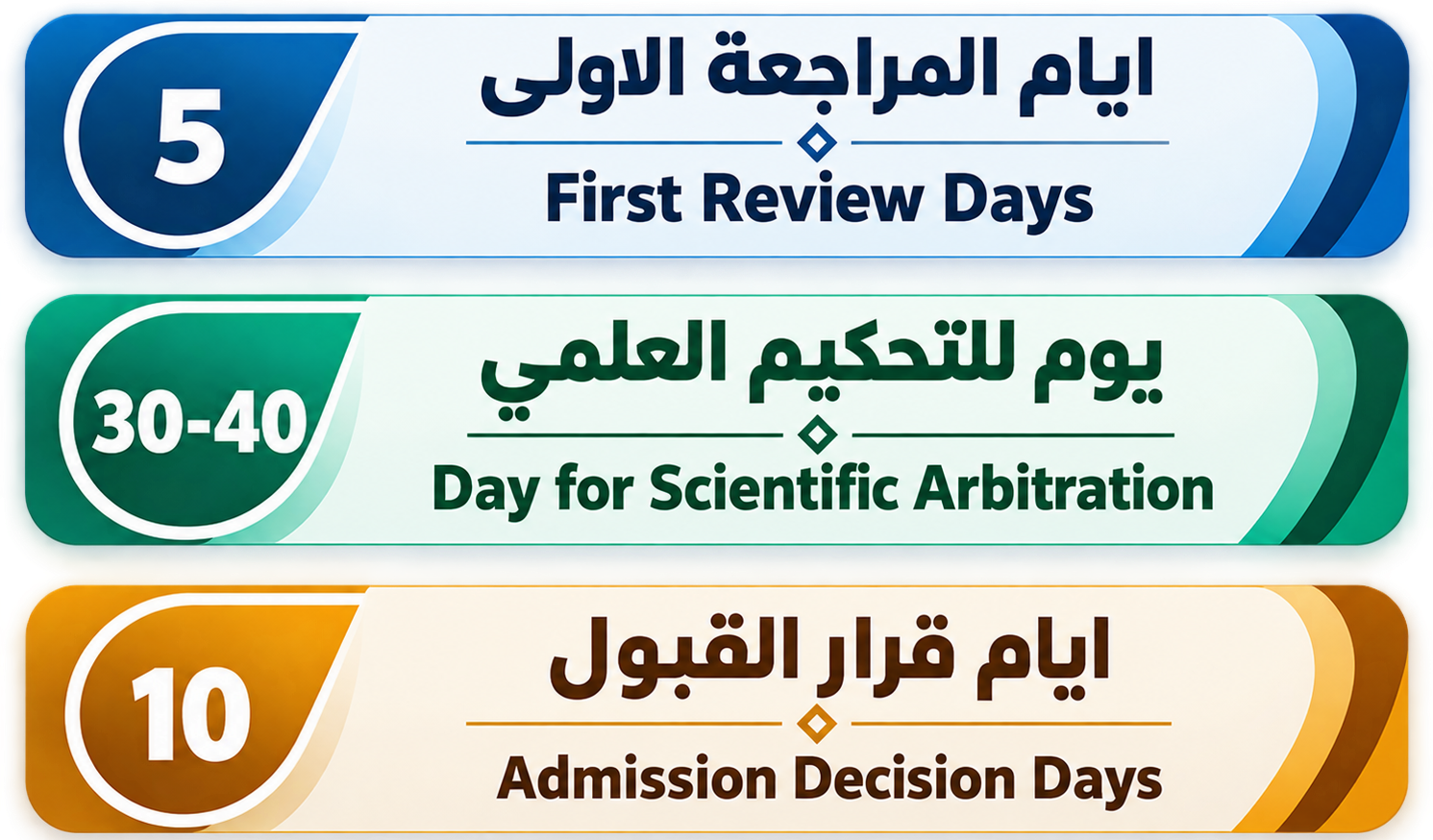
Peer Review Prosses
Overview
AL-Yarmouk Journal follows a double-blind peer review process, ensuring that both authors and reviewers remain anonymous throughout the evaluation. This process is designed to guarantee fairness, objectivity, and scientific quality in all published manuscripts.
2. Initial Screening
- All submitted manuscripts are first evaluated by the editorial office.
- The screening includes:
- Scope and relevance to the journal
- Basic formatting and adherence to author guidelines
- Similarity check using plagiarism detection tools
- Manuscripts that do not meet basic requirements may be rejected without external review.
3. Reviewer Assignment
- Manuscripts that pass the initial screening are assigned to at least two independent expert reviewers.
- Reviewers are selected based on:
- Subject expertise
- Absence of conflicts of interest
- Academic qualifications and publication record
4. Double-Blind Review
- The identities of authors and reviewers are kept strictly confidential.
- Reviewers evaluate manuscripts based on:
- Originality and novelty
- Scientific quality and methodology
- Clarity of presentation
- Validity of results and conclusions
- Relevance to the journal scope
5. Reviewer Recommendations
Reviewers may recommend one of the following decisions:
- Accept without revision
- Minor revisions required
- Major revisions required
- Reject
6. Editorial Decision
- The final decision is made by the Editor-in-Chief or handling editor.
- Decisions are based on reviewer reports and overall scientific merit.
- In case of conflicting reviews, the manuscript may be sent to an additional reviewer.
7. Revision Process
- Authors are required to respond to all reviewer comments point-by-point.
- Revised manuscripts may be re-evaluated by reviewers or editors.
- Failure to adequately address comments may result in rejection.
8. Confidentiality
- All manuscripts and review reports are treated as confidential documents.
- Reviewers and editors must not use unpublished material for personal research or advantage.
9. Ethical Considerations
- The journal follows COPE guidelines in handling peer review ethics.
- Any suspected misconduct (plagiarism, data fabrication, or ethical violations) is investigated thoroughly.
10. Appeals
- Authors may appeal editorial decisions following the journal’s official appeals policy.
- Appeals are reviewed independently and decisions are final after reconsideration.